
Managed Catering vs. Restaurant Delivery: What Actually Holds Up When You're Feeding 200 People
Most teams don't decide to change how lunch works. They drift into it. Delivery was fine at twenty people, and somewhere past fifty it became a recurring block on someone's calendar: collecting preferences, splitting the order across three restaurants so everyone's covered, sorting containers at the counter.
If you're weighing a managed food program against ordering in, the useful question isn't whether restaurant food is good. It's who's responsible for everything that surrounds it.
The comparison isn't restaurant food vs. catered food
Plenty of people frame this as a taste question, and that framing sends them down the wrong path. Great restaurants make great food. So do good catering kitchens. Dish for dish, you can find excellent versions of both.
The real difference is who absorbs the work. Restaurant delivery hands you food. A managed program hands you an outcome: the right amount of food, labeled, set up, replenished, cleaned up, invoiced once, with a person who answers when something slips. One is a transaction. The other is a service.
What restaurant delivery actually costs
The number on the checkout screen is the least reliable figure in this decision. A $1,400 lunch order is rarely a $1,400 line item by the time it clears accounting.
The price you see isn't the restaurant's price
Restaurants listed on delivery marketplaces pay commissions in the range of 15% to 30% per order, so most of them raise their listed prices to survive it. Independent write-ups of app pricing put the typical menu markup at 10% to 20%, averaging around 15%. That isn't the restaurant being greedy. It's arithmetic. But you're paying the spread on every dish, every week.
The fees stack on top of that
Then come the platform charges. ezCater's own guide to catering fees puts service fees at 5% to 20% of the order total, before delivery fees and tips. Now order from three places so the vegans, the celiacs, and the people who wanted tacos are all covered. Three minimums, three delivery fees, three service fees, three receipts to reconcile.
The line item nobody forecasts
Someone has to poll the team, place the orders, track the drivers, sort the containers, guess at the allergens, and call support about the missing entree. That someone is usually your office manager, and it lands mid-morning, every time lunch happens. It never appears on the invoice, which is exactly why it's easy to keep paying.
Add it up and the cost isn't just higher. It's unpredictable, which is worse if you're the person defending a quarterly food budget.
What a managed program does differently
Workplace Catering starts from the assumption that none of the above should be your problem. Our chefs build rotating menus, our team delivers and sets up, and someone from Just Fare stays accountable for how the whole thing lands.
In practice:
- Menus that scale. From 50 to 1,000+ people without falling apart, with enough rotation to stay interesting and not so much that it turns random.
- Dietary needs handled upstream. Vegetarian, vegan, and gluten-free options are planned into the menu and labeled before they reach the counter. Nobody has to interrogate a container.
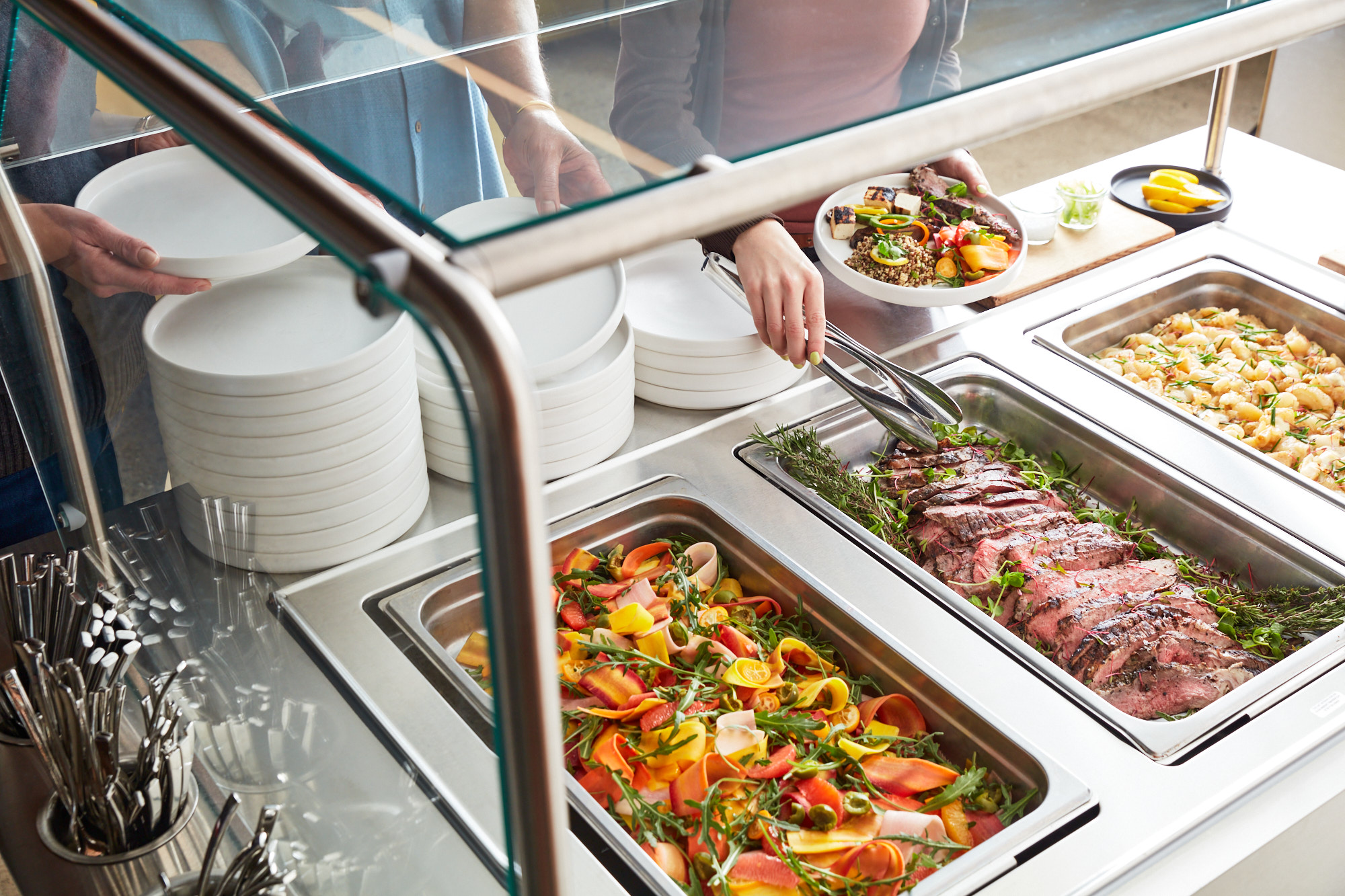
- Onsite hospitality. We set up, serve, replenish, reset, and clean, so the room is usable again by the 1:00 meeting.
- Headcount that flexes. Adjust from 10 to 1,000+ as the week moves. Tell us once, not in a ticket.
- One predictable invoice. No creeping fees, no surprise line items. We work inside your range and flag it early when something shifts.
- Actual visibility. A dashboard showing upcoming menus, headcount, spend, and what your team is really eating.
The food is still the reason people leave their desks. Lemon-Herb Chicken with Roasted Vegetables. Mediterranean Quinoa Bowls. Plant-Based Tofu Stir-Fry with Sesame Glaze. A salad bar built on seasonal greens, house-made dressings, and whatever the farms are cutting that week.
One more difference that won't fit in a cost comparison: 1% of our revenue funds Just Fare Community Kitchen, which has delivered more than 505,250 dignified meals across the Bay Area since 2020 through a network of 40+ hyper-local community organizations. Your Tuesday lunch keeps working after lunch.
You don't have to give up your team's favorite restaurants
This is where the versus framing really breaks down. Teams love restaurant days. They should. The variety is good for morale, and putting money into local kitchens is worth doing on purpose.
So we run them for you. Restaurant Partnerships brings rotating local restaurants into your office while we handle sourcing, ordering, vendor management, delivery coordination, onsite setup, and billing. Your team gets the neighborhood favorites. You get one point of contact, one consolidated bill, and reporting on what people actually ate.
For most offices that's the honest answer: a managed core program with restaurant days rotating through it. Variety on the menu, structure underneath.
Key Takeaways
Restaurant delivery is priced like a convenience and it behaves like one. For a team of eight, a one-off client lunch, or a Friday where nobody minds improvising, it's fine. Once you're feeding 50 or more on a schedule that repeats, the unmanaged version quietly costs more than it appears to, mostly in fees you didn't forecast and hours you never planned to spend.
Three questions will separate a delivery service from a food program. Who sets up and cleans? What happens when the headcount changes the morning of? And how many invoices do I get? Ask them early and the answer usually picks itself.
Ready to Elevate Your Office Catering?
Let's create a custom menu that keeps your team fueled and focused.